When you’re planning a trip to Australia, the big question is always, “How long will my visitor visa take?” For the most common one, the Subclass 600 Tourist stream, the answer can be anywhere from a couple of days to over a month. It really depends on your individual circumstances.
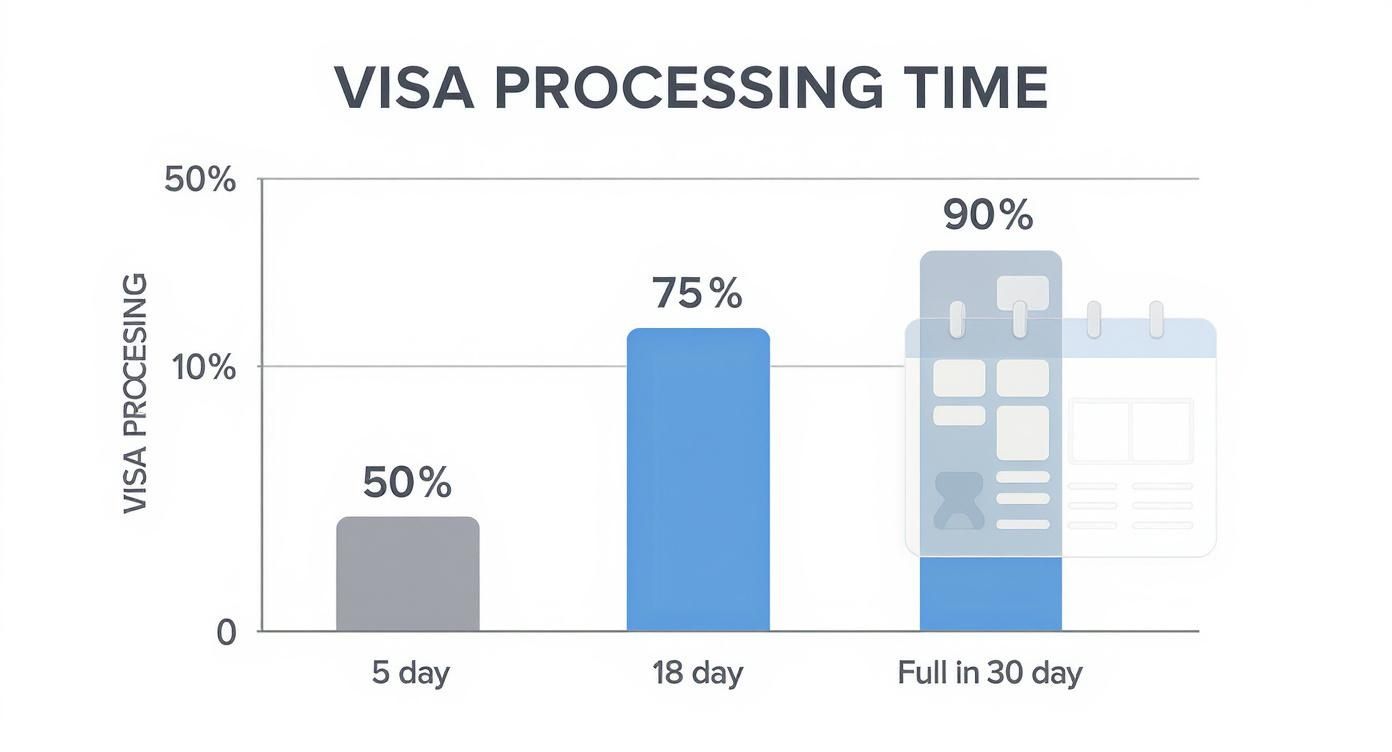
While many applications get a swift approval, the official figures show that about 50% are processed within 5 days. The vast majority, around 90%, are finalised within 30 days.
Decoding the Current Visa Processing Timeline
Figuring out the official processing times for an Australian visitor visa can feel a bit like trying to predict the weather. You have the official forecast, but your actual experience might be different. The Department of Home Affairs gives us benchmarks not as one fixed number, but as a percentile range.
Think of it like a queue for a popular concert. A few lucky people get through the gates almost instantly, most people wait a reasonable amount of time, but a small handful will always take longer because of extra ticket or security checks. It’s a much more realistic way to look at it, as it accounts for both the simple, straightforward applications and the ones that need a closer look.
By understanding these figures, you can get a much clearer idea of how long you might be waiting for that all-important decision.
A Snapshot of Visitor Visa Timelines
The Visitor Visa (Subclass 600) is the go-to for most tourists, and it’s a perfect example of how this percentile system works. The official data shows a pretty wide spread. For instance, a remarkable 25% of applications are processed in just one day – these are usually the perfectly prepared, clear-cut cases.
This infographic gives you a great visual breakdown of the typical processing milestones for the Subclass 600, showing how long it takes for most people to get an answer.
As you can see, half of all applicants get their visa decision within five days, but the timeline stretches out for more complicated applications, with 90% being finalised by the 30-day mark. Having this perspective helps you plan for the full range of possibilities.
To make this even clearer, here’s a simple table laying out the official timelines for the Visitor Visa (subclass 600) Tourist stream. It shows you the percentage of applications finalised within certain timeframes.
Visitor Visa (Subclass 600) Processing Time at a Glance
Percentage of Applications Processed
Timeframe
25%
1 Day
50%
5 Days
75%
18 Days
90%
30 Days
This table really highlights the spread. While it’s great that a quarter of people get an answer in a day, that 30-day figure for 90% of applications is the one you should keep in mind for safe and stress-free travel planning.
Understanding the Percentiles
So, what do these numbers actually mean for you? Let’s break it down.
50% of applications: Processed within 5 days. These are typically the “perfect” applications—complete, no mistakes, and often from low-risk countries.
75% of applications: Processed within 18 days. This group might include applications that need a quick follow-up for a missing document or were lodged during a busy holiday period.
90% of applications: Processed within 30 days. These are the more complex cases. They might require health checks, character assessments, or the Department might need to request more detailed information from you.
This tiered system is why planning ahead is so important. While the official 2025 data shows that speedy approvals are possible, relying on the 90th percentile figure of 30 days gives you the most reliable buffer. The goal, of course, is to prepare an application that has the best chance of falling into those faster brackets. If you want to learn more about the visa itself, have a look at our overview of the Australian tourist visitor visa.
The most significant takeaway is this: while a quick turnaround is possible, it’s never guaranteed. How long your visa takes is a direct reflection of how complex your situation is and how well you’ve prepared your application.
For anyone looking beyond a short stay, a comprehensive guide to Australia immigration provides fantastic insight into the different pathways available. It also helps to understand why the Australian government is so meticulous with all its visa assessments, including visitor visas.
How Different Visa Streams Impact Your Wait Time
Not all visitor visas are created equal. The purpose of your trip is one of the single biggest factors that will influence your Australia visitor visa processing time. A good way to think about it is like different lanes on a highway—some are built for speed, while others have more checkpoints and demand a more thorough inspection.
The Visitor Visa (Subclass 600) is broken down into several “streams,” and each one is tailored to a specific reason for travel. Knowing which stream you fall into is the first step to setting realistic expectations for how long you’ll be waiting for a decision.
Each stream comes with its own unique set of requirements and assessment criteria, and that directly impacts how quickly a case officer can get to the finish line.
The Tourist Stream: Standard Timelines
This is the go-to visa for holidaymakers and anyone visiting friends or family in Australia. Because it’s the most common path, the processing times can really vary. As we’ve seen, while many applicants get a result in under a week, it’s not at all unusual for 90% of applications to take up to 30 days.
Case officers are looking at things like your financial situation, your ties to your home country, and whether you genuinely plan to leave Australia after your visit. If any of these areas raise a red flag, your application will naturally take longer while the Department of Home Affairs digs a bit deeper. For a full rundown on what this involves, our guide on how to apply for the Tourist Stream from overseas is a great resource.
The Business Visitor Stream: The Fast Lane
If your trip is for business activities like attending a conference, negotiating a contract, or meeting with clients, you’ll be applying under the Business Visitor stream. This lane is often much, much faster. The reason is pretty straightforward: the purpose of the trip is specific and a lot easier for the Department to verify.
Applicants in this stream usually provide clear-cut evidence, like an invitation letter from an Australian company or a conference registration form. This kind of focused documentation makes the whole assessment process simpler. In fact, 75% of these applications are finalised within just 9 days, highlighting how efficient the system is for genuine business travellers.
The Sponsored Family Stream: The Most Detailed Path
This stream is designed for people who have an eligible family member in Australia willing to formally sponsor their visit. Because there’s a sponsor involved, this stream comes with the most rigorous checks and, as you might guess, the longest processing times.
The Sponsored Family stream requires verification of both the applicant and the sponsor. This includes checking the sponsor’s eligibility, financial capacity, and legal status in Australia, adding an entire layer of complexity to the application.
The Department has to be completely satisfied that the sponsorship is genuine and that the sponsor has the means to support the visitor. This dual-verification process can really stretch out the timeline, with processing times often hitting the 50 to 70-day mark.
Here’s a quick summary of how they stack up:
Visa Stream
Primary Purpose
Key Assessment Focus
Typical Processing Speed
Tourist Stream
Leisure, holidays, visiting friends/relatives
Genuine intent, financial stability, ties to home country
Moderate
Business Visitor
Meetings, conferences, negotiations
Legitimacy of business activities, invitation letters
Fast
Sponsored Family
Visiting family with formal sponsorship
Applicant’s eligibility and sponsor’s eligibility
Slow
By understanding which stream fits your trip, you can get a much clearer picture of the road ahead. A business traveller can confidently plan for a quick result, whereas someone applying through the Sponsored Family stream should settle in and prepare for a much longer wait.
What Speeds Up (or Slows Down) Your Visa Application?
Ever wondered why your friend’s visitor visa came through in a few days, while someone else is still waiting weeks later? The official processing times are just averages. In reality, the actual time it takes depends on a handful of key factors. Getting your head around these is the best way to control what you can and plan for what you can’t.
Think of it like handing over a project to someone. If you give them a perfectly organised folder with every single document they need, clearly labelled and in order, they can get the job done quickly. But if the file is a mess—documents are missing, scans are blurry, or information is contradictory—they have to stop, come back to you with questions, and wait. The whole project grinds to a halt.
Your goal is to hand the Department of Home Affairs that perfectly organised folder from day one. This is what’s known as a ‘decision-ready’ application, and it’s your single biggest advantage in speeding things up.
The Power of a Decision-Ready Application
A decision-ready application is exactly what it sounds like: it’s so complete and well-prepared that a case officer can make a decision without needing to ask you for a single extra thing. This is where most people trip up and where most delays come from.
Getting it right means more than just filling in the boxes on the form. It’s about anticipating what a case officer needs to see and providing the proof upfront.
Complete and Accurate Info: Every single question needs an answer. Blank fields or vague responses are immediate red flags that invite questions and delays.
Top-Quality Documents: All your supporting documents—bank statements, passport pages, letters of invitation—must be high-resolution, crystal-clear scans. A blurry photo of your passport is a guaranteed way to get a “Request for Information,” adding weeks to your wait time.
A Coherent Story: The evidence you provide has to paint a clear, consistent picture. It should logically support your reasons for visiting and, most importantly, show that you have every intention of returning home.
A decision-ready application simply makes the case officer’s job easy. When they have everything they need right there, the path to a quick approval is wide open.
It’s also crucial to ensure all the necessary payments and documentation are correctly submitted from the get-go. For instance, being aware of things like understanding visa integrity fees and related requirements can make a real difference and prevent unnecessary hold-ups.
The Big Factors Beyond Your Control
Even with a perfect application, some things that influence the Australia visitor visa processing time are simply out of your hands. It’s important to know what they are so you can manage your expectations and travel plans.
The two biggest external factors are your country of citizenship and how busy the Department is at any given time.
1. Country of Citizenship and Risk Profiles
The Department of Home Affairs doesn’t treat every application identically; it uses a risk-based approach. This means that applications from certain countries might face more in-depth checks, usually based on historical data about visa compliance. It’s not personal—it’s a statistical measure. If you’re applying from a country considered higher risk, you should expect more thorough background checks, which naturally takes more time.
2. Application Queues and Peak Seasons
The Department handles a staggering number of visa applications every year. When you apply, you’re joining a global queue. How fast that queue moves depends on how many other people lodged their applications around the same time. Unsurprisingly, things slow down considerably during peak travel periods like Christmas, school holidays, and major cultural festivals when visitor visa demand goes through the roof.
Potential Roadblocks: Health and Character Checks
The final piece of the puzzle involves health and character checks. These aren’t required for everyone, but if they are triggered for you, they can add significant time to the process.
Health Examinations: You might be asked to have a medical exam if you’re staying for a long time, have pre-existing health issues, or come from a country with particular public health concerns (like tuberculosis). This isn’t just a quick check-up. It involves booking an appointment with a specific, government-approved doctor, doing the tests, and then waiting for the results to be sent to and reviewed by the Department. This can easily add several weeks to the clock.
Character Requirements: If you have any kind of criminal record—even for something that seems minor—you’ll face a detailed character assessment. This almost always involves getting police clearance certificates from every country you’ve lived in for 12 months or more over the past decade. Just gathering these documents can be a long process, let alone the time it takes for the Department to review them.
By understanding these key factors—the importance of a solid application, the external realities of queues and risk profiles, and the potential for extra checks—you can set yourself up for the smoothest possible visa journey.
How to Check Your Application Status in ImmiAccount
So, you’ve lodged your visitor visa application. Now comes the hard part: the wait. But instead of refreshing your inbox every five minutes, you can actually keep tabs on your application’s progress yourself through the Department of Home Affairs’ online portal, ImmiAccount.
Think of ImmiAccount as your personal dashboard for your visa journey. It gives you a real-time look at where your application is, from the moment it lands in the system to the final decision. This is far more useful than just looking at the global processing time estimates, which are only averages. Your ImmiAccount shows you the actual status of your application.
Checking in regularly isn’t just for peace of mind. It’s also the best way to make sure you don’t miss any important requests from the Department—a surprisingly common reason for delays.
A Quick Guide to Checking Your Status
Getting an update is pretty simple. Once you’ve done it a couple of times, it’ll become second nature.
Find your application: On the main screen, you’ll see a list of your applications. Just find the visitor visa you’re tracking.
Check the status: The current status is shown right there next to your application details. You can click on it for a more detailed view.
Here’s what that dashboard typically looks like. You’ll see your application list and their status at a glance.
This simple view gives you an immediate update, telling you exactly where things are without you having to pick up the phone.
What Do These Statuses Actually Mean?
The terms used in ImmiAccount can be a bit like government jargon at times. Knowing what each one means will help you understand exactly what’s happening with your file.
Here’s a plain-English breakdown of the most common statuses you’ll see:
Submitted: This is the starting line. It means the Department has successfully received your application and payment. You’re officially in the queue.
Initial Assessment: A case officer has now picked up your file and is doing the first review. They’re checking that all your documents are there and making sure your application meets the basic criteria.
Further Assessment: This one sounds serious, but it’s very common. It just means the case officer needs something else from you. This is a critical point—you need to log in and check your messages for a Request for Information (RFI) and get a response in ASAP.
Finalised: This is it—the finish line. A decision has been made. Check your ImmiAccount messages for the official notification letter, which will tell you if the visa has been granted or refused.
Don’t panic if you see ‘Further Assessment’. It doesn’t mean your application is in trouble. It’s a standard step when the case officer just needs a bit more information to tick all the boxes. Your swift response here is the single best thing you can do to keep your application moving.
Common Application Mistakes and How to Avoid Them
It’s a frustrating truth, but some of the longest delays in getting an Australia visitor visa come down to simple, preventable errors. While you can’t control how busy the Department is, you absolutely can control the quality of the application you submit. Getting this right isn’t about luck; it’s all about careful preparation.
Think of your application as the only thing a case officer knows about you. If it’s messy, incomplete, or confusing, they’re not going to be filled with confidence. They’ll have questions, and that means delays. A clean, complete, and logically organised application, on the other hand, makes their job easier and keeps your file moving smoothly through the system.
So, let’s walk through the most common pitfalls I see all the time. I’ll break them down in a simple problem-and-solution format to give you a clear pre-submission checklist.
Problem One: Incomplete or Inconsistent Information
This is probably the biggest red flag for a case officer. Leaving fields blank or, even worse, providing details that contradict your other documents is a sure-fire way to get your application paused.
Imagine the case officer sees your application form says you started a job in June, but the reference letter from your employer says July. It’s a small detail, but it immediately creates doubt and forces them to stop, issue a Request for Information (RFI), and wait for your response. That one little slip-up can easily add weeks to your timeline.
Solution: Double-check everything. Then check it again. Go through your application form line-by-line and compare it directly against your supporting documents—your passport, bank statements, pay slips, and letters. A great trick is to have a friend or family member give it a final once-over. A fresh set of eyes can often spot a mistake you’ve looked at ten times and missed.
Problem Two: Poor-Quality Document Scans
Submitting a blurry, cropped, or unreadable document is like mumbling during an important interview. If the case officer can’t clearly read the name on your passport or make out the numbers on your bank statement, they simply can’t do their job.
This isn’t a minor issue they’ll just overlook. It brings the entire assessment process to a halt. You’ll get an RFI asking for better copies, and your application gets put to the back of the queue until you provide them.
Remember, the case officer can only assess the evidence you provide. If they can’t read it, for all intents and purposes, it doesn’t exist. This single error can be the difference between a quick approval and weeks of unnecessary delay.
Solution: Take the time to make good-quality, full-colour scans. It’s worth the extra effort.
Use a proper scanner: Your phone camera might be convenient, but a flatbed scanner gives a much clearer, more professional result.
Check the resolution: Aim for at least 300 DPI to ensure everything is sharp and legible.
Scan the whole page: Don’t crop the edges. For passports, make sure all four corners of the main photo page are visible in the scan.
Label your files clearly: Naming files like “Passport_Bio_Page.pdf” or “Bank_Statement_Jan_2025.pdf” is a small step that makes a big difference, both for your own organisation and for the person reviewing your file.
Problem Three: Missing a Request for Biometrics
If you’re applying from certain countries, providing biometrics (a photo and your fingerprints) is a non-negotiable step. After you lodge your application, the Department will send a request letter to your ImmiAccount, telling you to go and get this done.
The problem is, many people submit their application and then stop checking their account, assuming the hard part is over. If you miss that notification and don’t provide your biometrics within the timeframe (usually 28 days), your application will be stalled. Worse, it could be refused altogether for failing to comply.
Solution: Get into the habit of logging into your ImmiAccount every couple of days after you submit. This is your main line of communication with the Department. The moment you see that biometrics request letter, download it and book your appointment. Don’t put it off—appointment slots can fill up fast, especially during holidays. Staying on top of this keeps your application moving forward.
Your Top Questions Answered
The visa application process can feel like a maze, and it’s natural to have questions pop up along the way. Here are some clear, straightforward answers to the queries we hear most often about the Australia visitor visa processing time, designed to help you plan your trip with a bit more certainty.
Can I Pay Extra to Speed Up My Visitor Visa Processing?
That’s a common question, but unfortunately, the answer is no. The Australian Department of Home Affairs doesn’t offer a paid priority or fast-track service for the Visitor Visa (Subclass 600).
The best—and only—way to get a faster decision is to lodge a complete and accurate “decision-ready” application from the get-go. This means giving the case officer everything they need upfront, so they don’t have to pause your application to ask for more information. That back-and-forth is what causes most delays.
What Should I Do if My Visa is Taking Longer Than the Advertised Time?
It’s definitely stressful when the weeks tick by. If your application has gone past the 90th percentile timeframe (which is often around 30 days for the Tourist stream), the first thing to do is log back into your ImmiAccount. Double-check all your messages and correspondence; it’s surprisingly easy to miss a request for more information.
If there’s nothing outstanding and you haven’t heard anything, you can use the Department’s official online enquiry form to follow up. Just be patient and avoid sending multiple messages, as this won’t speed things up and can actually create a backlog for them. For a wider view on visa timings, our article on the general processing time for Australian visas offers some great context.
Does My Country of Citizenship Really Affect the Processing Time?
Yes, it absolutely can, and often does. The Department of Home Affairs uses a risk-based assessment approach. This means applications from countries with a history of lower visa compliance may face more detailed background and security checks.
It’s nothing personal against you. It’s just a standard procedure that means the Department might take a bit longer to verify all your details and confirm your intentions. This can add extra time to your application compared to those from lower-risk countries.
The key takeaway here is that while you can’t change your citizenship, knowing it might be a factor helps you build a more realistic timeline into your travel plans and avoid that last-minute stress.
If My Visa is Delayed Does It Mean It Will Be Refused?
A delay is not a sign of a refusal. A long wait is usually down to administrative reasons—things like a huge number of applications coming in during peak season, your case needing complex health or character checks, or the Department simply waiting on information from another agency.
A refusal, on the other hand, is a final decision made because an applicant doesn’t meet the specific legal requirements for the visa. The processing time and the final outcome are two separate things, so don’t assume the worst just because it’s taking a while.
Can I Book Flights Before My Visitor Visa is Granted?
We strongly advise against this. Please do not book non-refundable flights or lock in any travel plans until you have the official visa grant notice in your hands.
The processing times published by the Department are only estimates, not guarantees. Your application could easily take longer than the average for any number of reasons. Waiting to book protects you from losing money and the headache of rescheduling everything. Always secure your visa first, then book your trip.
Will Requesting a Longer Stay Increase My Processing Time?
It can, yes. Asking for a longer stay, like for six or twelve months, often triggers a more thorough assessment from the case officer, which can extend the processing time. They need to be completely convinced you have enough money to support yourself for that entire period and that your reasons for staying so long are genuine.
This usually means they’ll take a much closer look at your bank statements and your ties to your home country (like your job, family, or property). While it’s not a given that it will take longer, you should expect more scrutiny than you’d get for a standard three-month tourist application.
Navigating the complexities of Australian visa applications requires expertise and a deep understanding of the current legislative landscape. At VisaTasker, our MARA-registered migration agents provide tailored advice to ensure your application is decision-ready, maximising your chances of a smooth and timely outcome. Whether you’re planning a short visit or a long-term move, let us help you achieve your Australian goals. Learn more about our services at VisaTasker.
Frequently Asked Questions
What is the fastest way to get an Australian visitor visa?
The fastest way is to submit a “decision-ready” application through the Business Visitor stream, as these are often prioritised and require verifiable evidence like conference invitations. For the more common Tourist stream, ensuring your application is complete, accurate, and includes high-quality document scans is the best strategy to avoid delays and fall into the faster processing percentiles.
Can I contact the Department of Home Affairs to check my visa status?
While you can use their online enquiry form if processing times have significantly passed the 90th percentile mark, the most efficient method is to regularly check your ImmiAccount. Your ImmiAccount provides real-time status updates and is the primary channel for any communication or requests for more information from your case officer.
Does applying during a certain time of year affect the visa processing time?
Yes, absolutely. Applying during peak travel seasons like the Christmas holidays (December-January) or major school holiday periods can lead to longer processing times. The Department receives a much higher volume of applications during these months, which can extend the queue and create a backlog.
What happens if I make a mistake on my application after submitting it?
If you realize you have made a mistake, you should log into your ImmiAccount and upload a Form 1023 (Notification of incorrect answer(s)). Correcting the error proactively shows transparency and is much better than waiting for a case officer to find it, which would cause significant delays while they request clarification.
How much money do I need to show for an Australian visitor visa?
There is no exact magic number, but you must demonstrate you have sufficient funds to cover your travel, accommodation, and living expenses for the duration of your stay. A general guideline is to show access to atleast AUD $300 per day, supported by recent bank statements that show a consistent savings history, not a last-minute deposit.
Disclaimer: This is general advice only and may not apply to your specific circumstances. For personalised guidance on your visa application, please book a consultation with one of our registered migration agents.
This article is written and reviewed by VisaTasker Migration Services, a MARA-registered migration agency based in Australia. As registered agents, we are bound by the Migration Agents Code of Conduct and required to provide accurate, up-to-date advice based on Australian migration legislation. Information is reviewed against the latest Department of Home Affairs policy.