So, you’re thinking about applying for an Australian visa. The whole process can feel a bit overwhelming, but it really boils down to getting one thing right from the start: matching your situation to the right visa stream. Before you even think about documents or forms, you need to figure out which pathway makes sense for you. This is the single most important step, and getting it right saves you a world of trouble later on.
Choosing The Right Australian Visa Path
Before getting buried in paperwork, the first real task is to understand the lay of the land. This isn’t just about picking a visa off a list; it’s about making a strategic choice that aligns with your goals for coming to Australia. The whole system is set up to meet specific needs—whether that’s filling a skills shortage or bringing families together—and knowing how your plans fit into that puzzle is key.
Decoding The Main Visa Categories
The reason you want to come to Australia will point you toward the right visa category. Each one is built for a very specific purpose.
Visitor Visas: Perfect for tourism, visiting family, or short business meetings. Just remember, you can’t work on these.
Student Visas: This one’s for anyone officially enrolled in a registered course at an Australian institution.
Skilled Visas: A pathway for professionals with occupations on Australia’s skills-in-demand list. It’s often a points-based game.
Partner Visas: For those who are married to or in a de facto relationship with an Australian citizen or permanent resident.
Employer-Sponsored Visas: This is when an Australian company sponsors you to come over and fill a specific job.
It’s always a good idea to start by looking into the general visa requirements for foreign travel to get a feel for the basics. This gives you a solid foundation before diving into Australia’s more specific rules.
To give you a clearer picture, here’s a quick rundown of the most common options.
Quick Guide to Common Australian Visa Streams
Visa Category
Primary Purpose
Ideal Applicant
Visitor (Subclass 600)
Tourism, family visits, short business trips
Tourists, people visiting relatives, business professionals attending meetings.
Student (Subclass 500)
Full-time study at a registered institution
International students enrolled in a CRICOS-registered course.
Skilled Independent (Subclass 189)
Skilled work without employer sponsorship
Highly skilled workers with occupations on the demand list who meet the points test.
Partner (Subclass 820/801 or 309/100)
To live with a partner who is an Australian citizen/permanent resident
Spouses or de facto partners in a genuine, ongoing relationship.
Temporary Skill Shortage (Subclass 482)
To fill a skilled position for an approved employer
Skilled workers sponsored by an Australian business to address labour shortages.
This table should help you quickly see where you might fit in, but it’s just the starting point.
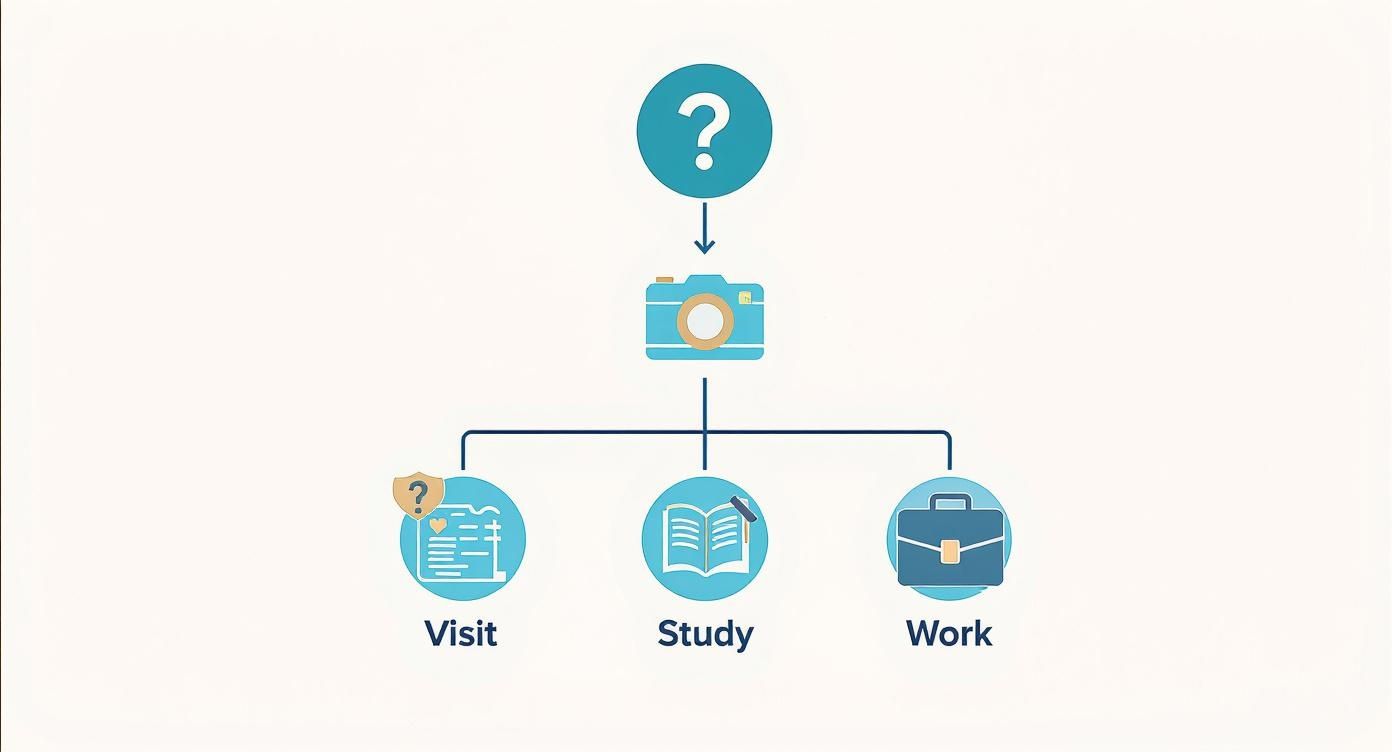
This infographic is a great way to visualise that first big decision you need to make.
As you can see, everything flows from your primary reason for coming to Australia—whether it’s to visit, study, work, or join family.
Understanding Current Migration Priorities
Here’s something many people overlook: Australia’s migration program isn’t static. It changes based on the country’s economic needs, which means some applications get a fast pass while others wait. For instance, if you’re a healthcare professional or willing to work in a regional area, your application will likely be prioritised because you’re filling a critical gap.
The competition is fierce. The number of temporary visa holders in Australia recently hit a staggering 2.90 million people as of September 30, 2025. Within that group, there were 736,306 student visa holders and 217,624 graduate visa holders, which shows just how popular the study and post-study work routes are.
Your chances of success often hinge on how well your application aligns with what Australia needs right now. Applying for a skilled visa in a high-demand field gives you a much stronger position than trying for an occupation where there’s already plenty of local talent.
This is exactly why a one-size-fits-all approach just doesn’t work. You need to understand the nuances of each stream. For a much deeper look into the different options, check out our comprehensive guide to securing the right visa. It’s all about playing to your strengths and choosing the path of least resistance from the get-go.
Getting Your Application Ready to Go
Alright, you’ve figured out which visa stream is the right fit. Now comes the hands-on part: preparing and lodging your application. This is where the rubber meets the road, turning all that research into a formal submission to the Department of Home Affairs.
Everything happens online through a portal called ImmiAccount. Seriously, this will be your new best friend (or sometimes, your nemesis). It’s the central hub where you’ll fill out your life story, upload your precious documents, pay the fees, and anxiously await updates.
First Things First: Your ImmiAccount
Before you can even start an application, you need to create your ImmiAccount. It’s a pretty standard online registration, but getting the small details right from the very beginning can save you a world of pain down the track.
Your email is everything. Use an email address you’ll have access to for years, not your old university one that’s about to expire. All official communication, including the final visa grant, will land there.
Triple-check your details. Your name, date of birth, and passport number must be an exact match to your documents. Even a tiny typo can throw a spanner in the works and cause major delays.
Security questions matter. Don’t just throw in random answers you’ll forget. Pick something memorable to you but not obvious to others; you’ll be grateful you did if you ever need to recover your account.
A handy feature is that you can manage multiple applications from one ImmiAccount. So, if you’re applying as a family, you can keep everything organised and see everyone’s progress in one place.
Tackling the Online Application Form
Once your ImmiAccount is set up, it’s time to dive into the application form itself. Be prepared – these forms are long and incredibly detailed, sometimes spanning 20 pages or more. The good news is you can save your progress and come back to it, so don’t feel you have to do it all in one sitting.
Pay very close attention to any question that asks for a detailed explanation. This could be about your travel history, your genuine reasons for visiting Australia, or the nitty-gritty of your relationship for a partner visa. Vague, one-word answers are a massive red flag for case officers. They’re looking for a clear, consistent story.
One of the most common trip-ups I see is the “family unit” question. In Australian migration law, this has a very specific meaning. It generally only covers your partner (married or de facto) and your dependent children under 23. It doesn’t include your parents, siblings, or cousins. Getting this wrong can lead to an incorrect declaration, which is a serious issue.
Before you even think about hitting that ‘submit’ button, go back and review every single answer. Once an application is lodged, you can’t just log back in and edit the form. You have to submit a separate “Notification of Incorrect Answer(s)” form, which just adds unnecessary complexity.
Paying the Piper: The Visa Application Charge
After you’ve filled everything out, the system will prompt you to pay the Visa Application Charge (VAC). The cost can vary wildly. A standard Visitor visa (Subclass 600) might set you back AUD 195, but a complex skilled or partner visa can run into the thousands.
You can usually pay with:
Credit Card (Visa, MasterCard, Amex, etc.)
PayPal
UnionPay
BPAY (this option is only for applicants inside Australia)
A quick tip: credit card payments almost always have a surcharge. Also, make sure your card has enough funds and is cleared for international payments. The last thing you want is for a payment to fail, as this can delay the official lodgement date of your application.
The Waiting Game: Tracking Your Application
With your application submitted and paid for, your ImmiAccount now shifts into its role as your tracking portal. You’ll see the status change as it moves through the system, and it helps to know what these mean so you can manage your expectations.
Application Status
What It Usually Means
Received
They’ve got it. Your application is officially in the queue.
Initial Assessment
Someone might be doing a quick check to see if all the basic documents are there.
Further Assessment
This is the important bit. A case officer is actively looking at your file and assessing your eligibility.
Finalised
A decision has been made. Check your messages for the good (or bad) news.
While the status gives you a bird’s-eye view, the real action happens in your ImmiAccount inbox. Check it religiously. This is where any “Request for Further Information” (RFI) will appear, and responding to these quickly is absolutely vital to keep things moving.
Gathering Your Essential Documents
A successful visa application is built on a foundation of solid, well-organised paperwork. This stage isn’t just about ticking boxes; it’s about painting a clear and consistent picture for the case officer reviewing your file. Think of every document as a piece of a puzzle. When they all fit together perfectly, they tell a compelling story and make a strong case for your visa.
It’s absolutely critical to understand what makes for strong documentary evidence. This is less about the quantity of paper and more about the quality and relevance. Every scan, from your passport to a bank statement, must be legitimate, easy to read, and directly support the claims you’re making in your application.
Beyond The Basics: Core Documentation
Every single visa application needs a set of foundational identity documents. While this might seem straightforward, getting these details wrong can stop an application in its tracks.
Passport: You’ll need a high-quality colour scan of your passport’s bio-data page. Make sure it has at least six months of validity left from your planned entry date and that the scan is crystal clear. No blurriness!
Birth Certificate: This is your primary proof of identity and family connections. If it’s not in English, you must get it translated by a certified translator.
National Identity Card: If your home country issues one, provide a clear scan of both the front and back.
Passport-Sized Photographs: These come with very specific rules about size, background, and even your facial expression. It’s always best to check the Department of Home Affairs website for the very latest photo specifications before you get them taken.
These documents are the bedrock of your application. They are the first thing a case officer looks at to confirm who you are.
Proving Your Case: Visa-Specific Evidence
Right, this is where the detailed work really kicks in. The type of evidence you need to collect will change dramatically depending on which visa you’re applying for. Your goal here is to anticipate every question a case officer might have about your eligibility and provide the answer before they even have to ask.
For instance, someone applying for a Skilled Visa needs to prove their qualifications and work history. A CV alone won’t cut it. You’ll need things like:
A positive skills assessment from the correct authority for your occupation.
Detailed employment reference letters written on official company letterhead.
Payslips, tax records, or superannuation statements to back up every claim of employment.
On the other hand, a Partner Visa application is all about proving your relationship is genuine and ongoing. The evidence is completely different. You might provide:
Joint bank account statements showing you share finances.
Photos of the two of you with family and friends, taken over a long period.
Statutory declarations from Australian citizens or permanent residents who can personally vouch for your relationship.
Financial Capacity and Certified Documents
For many visa types, especially student and visitor visas, you have to prove you can support yourself financially. It’s not enough to just show a large lump sum in a bank account. You need to demonstrate where that money came from. This often means providing several months of bank statements to show a consistent savings history or proof of regular income.
Also, be aware that many official documents, like academic transcripts or police certificates, might need to be certified copies. This means a qualified person (like a Justice of the Peace or a notary public) has sighted your original document and officially verified that your copy is true and accurate.
Always double-check the specific document checklist for your visa subclass. Submitting a plain copy when a certified one is required is a common mistake that can cause major delays or a formal Request for Information, stalling your application indefinitely.
Meeting Health and Character Requirements
Every single person applying for an Australian visa has to meet the country’s health and character standards. This isn’t optional; it’s a fundamental part of the process designed to keep the Australian community safe.
The character requirement is mainly assessed through police clearance certificates. You will need to get one from every country you have lived in for 12 months or more over the last 10 years. My advice? Start this process as early as possible. Some countries can take weeks, or even months, to issue these certificates.
For the health requirement, you may need to book a medical examination with a government-approved panel physician. This isn’t something your local GP can do. The exam usually includes:
A general physical check-up
A chest X-ray
Blood tests for specific conditions like HIV
The clinic will send the results directly to the Department of Home Affairs, so you don’t have to worry about uploading them. Getting these checks done proactively is one of the best ways to ensure your application is “decision-ready” and avoid any frustrating, preventable delays.
Understanding Visa Processing Times and Priorities
So you’ve lodged your application. Now comes the hard part: the waiting. This is often the most nerve-wracking stage of the whole journey, but knowing what’s happening behind the scenes can make it a lot more manageable.
It’s a common misconception that applications are processed in a simple first-in, first-out queue. The reality is quite different. The Australian government has a strategic approach, prioritising certain visa applications to meet the country’s economic and social goals. This directly influences how long you’ll be waiting for that final decision.
This priority system isn’t arbitrary. It’s a carefully managed process. For example, if there’s a critical shortage of nurses or software engineers, applications from people in those fields often get pushed to the front of the line. The same goes for visas that encourage people to settle in regional areas or bring significant business investment into the country.
Why Some Applications Move Faster Than Others
So, what determines your spot in the processing queue? It really boils down to a mix of government policy, the specific visa you’re applying for, and frankly, how well you’ve prepared your application.
Ministerial Directions: These are the big-picture drivers. The Minister for Immigration can issue legally binding directions that tell the Department exactly which applications to process first. These often target high-demand skills, specific industries like healthcare and teaching, or certain visa categories to address immediate national needs.
Application Completeness: This is the one you have the most control over. A “decision-ready” application—one with every single required document and piece of evidence included from day one—will almost always move through the system faster. An incomplete application, on the other hand, gets a Request for Further Information (RFI), which effectively stops the clock on your file and puts it on hold.
Location of Applicant: Sometimes, it matters whether you apply from inside Australia (onshore) or from overseas (offshore). Different departmental teams handle these caseloads, which can lead to different processing times.
The single biggest controllable factor in your processing time is the quality of your submission. Every missing document or inconsistent piece of information creates a delay that is entirely preventable.
Real-World Timelines Across Different Visa Streams
Processing times can vary wildly from one visa to another, directly reflecting their priority level. Some employer-sponsored visas, for instance, have premium processing options that can deliver a decision in just a few days, while other streams might see you waiting for well over a year.
For a clearer picture, let’s look at some typical timelines.
Typical Australian Visa Processing Timelines
The table below gives you a general idea of what to expect for some of the more common visa types. Keep in mind these are just estimates and can shift based on how many applications the Department is receiving and any changes in government priorities.
Visa Subclass
Estimated Standard Processing Time
Notes on Priority Processing
Visitor (Subclass 600)
2-4 weeks
Generally processed in order of receipt, but urgent compassionate cases can be expedited.
Student (Subclass 500)
1-3 months
Applications linked to certain education providers or countries may be processed faster.
Skilled Independent (189)
8-14 months
Processing is heavily influenced by points score and occupation. Higher points often lead to faster invitations.
Partner (Subclass 820/309)
12-24 months
These are complex and often lengthy. Decision-ready applications are crucial to avoid extra delays.
TSS (Subclass 482)
1-2 months
Priority is given to accredited sponsors and occupations in critical sectors.
These timeframes are a great starting point, but they are not set in stone. For a more detailed breakdown of what to expect, you can learn more about what is the processing time for Australian visas in our dedicated guide.
Ultimately, having a realistic understanding of these timelines helps you plan your future—whether it’s for work, travel, or starting a new life—with much less stress while you wait for that all-important decision.
When to Work With a MARA Registered Agent
Many people successfully tackle the visa process on their own, and for some, it’s a perfectly manageable task. But there are times when a seemingly straightforward application can spiral into a complex, high-stakes puzzle. Deciding to bring in a professional isn’t just about paying for help; it’s a strategic investment in getting it right the first time.
The key is knowing when your situation has crossed the line from simple to complicated.
While a standard visitor or initial student visa can often be handled solo, professional guidance becomes essential when the path isn’t so clear-cut.
Red Flags That Your Application Is Complex
Certain issues will immediately make your application more challenging. If any of these sound familiar, getting an expert involved early can save you from a world of stress, wasted money, and a potential refusal.
You’ve had a previous visa refusal. This is a big one. Any future application you lodge will be under a microscope. A MARA agent can analyse exactly why you were refused and help you build a much stronger case that directly addresses the Department’s original concerns.
There are character or health issues. Things like a past criminal charge (even something you think is minor) or a significant health condition need to be handled with extreme care. An agent knows precisely how to declare this information and what kind of supporting evidence is needed to meet Australia’s very strict requirements.
Your case involves a complex sponsorship. Partner visas, for instance, aren’t just about paperwork; they’re about proving a genuine relationship to a case officer. Employer-sponsored visas come with a minefield of legal obligations for the business. An agent makes sure the evidence is not just present, but compelling.
High-Stakes Scenarios and Shifting Goalposts
For a business, sponsoring a skilled worker isn’t just an administrative task—it’s often a critical operational necessity. A delay, or worse, a refusal, can derail projects and hit the bottom line. Handing it over to an agent lets you focus on running your business.
It’s also crucial to remember that immigration policy isn’t static. It’s constantly changing. Just look at the permanent migration program for 2024-25. The government has boosted places for Employer-Sponsored visas to 44,000 while slashing the Skilled Independent visa allocation to just 16,900. This sends a clear signal about current priorities, and an agent’s job is to stay on top of these shifts to position your application for success.
A MARA-registered agent does more than fill out forms. They craft a strategy based on your unique profile and the ever-changing migration landscape. This expert approach is what genuinely improves your chances of a positive outcome.
The True Value of Professional Expertise
At the end of the day, using an agent is about managing risk. If you have a simple, low-risk application, you might be perfectly fine on your own. But when your case is complex or the stakes are high, the potential cost of a refusal—in lost fees, time, and future opportunities—is far greater than an agent’s professional fees.
A good agent acts as a critical safety net. They spot potential problems you’d never see and fix them before they become deal-breakers for the Department of Home Affairs. You can dive deeper into the benefits of using a MARA-registered migration agent to understand how this expertise can change your entire immigration journey. It could be the smartest decision you make.
Your Top Australian Visa Questions, Answered
Going through the Australian visa process always sparks a few questions. It’s completely normal. To give you some clarity, I’ve put together answers to the most common queries we hear from people just like you. Think of this as a quick reference guide to help you keep moving forward.
What’s the biggest reason a visa gets refused?
Nine times out of ten, it comes down to incomplete or inconsistent information. This is the number one reason we see applications get rejected. It can be something as simple as a missing document, but more often, it’s about contradictions in the story you’re telling.
For example, you might state you worked at a company for three years on your form, but the reference letter you provide only covers two. That’s a huge red flag for a case officer. They’re trained to spot these inconsistencies, and even a small, honest mistake can be seen as an attempt to mislead them.
Your best defence is to double- and triple-check everything before you lodge. Make sure the dates line up, the names are spelled correctly, and your evidence paints a clear, consistent picture.
Can I work in Australia while I wait for my visa decision?
This is a great question, and the answer depends entirely on your current visa situation. If you’re already in Australia on a valid visa (like a student or visitor visa) and you apply for another one, you’ll usually be granted a Bridging Visa A (BVA).
The BVA is your legal permission to stay in Australia after your first visa expires but before a decision is made on your new one. Critically, the work rights on your BVA typically mirror the conditions of your previous visa. So, if you were on a student visa with a 40-hour-per-fortnight work limit, your BVA will likely have that same restriction. Always read your bridging visa grant notice carefully—it spells out exactly what you can and can’t do.
How much money do I actually need in my bank account?
There’s no single magic number here; the “proof of funds” requirement changes drastically depending on the type of visa you’re after.
Student Visas (Subclass 500): This is one of the most specific. You generally have to show you have enough money to cover your first 12 months of tuition fees, living costs (which is a figure set by the government), and your travel expenses.
Skilled Visas: Most skilled migration pathways don’t have a mandatory bank balance you need to show. That said, proving you have some settlement funds to support yourself while you find a job can definitely strengthen your application. It just makes sense.
Visitor Visas: You need to convince them you can afford your trip, but there’s no set amount. A case officer will look for a reasonable sum based on how long you plan to stay and what you intend to do.
It’s not just about having a large sum in your account. The Department of Home Affairs is more interested in seeing a stable financial history and a legitimate source for your funds. A sudden, large deposit right before you apply can look suspicious.
I’ve submitted my application and just found a mistake. What now?
Don’t panic! The most important thing is to be upfront about it. If you realise you’ve made an error after lodging, you need to notify the Department of Home Affairs straight away.
The official way to do this is by completing a Form 1023 (Notification of incorrect answer(s)). In this form, you explain what the mistake was and provide the correct information. Once it’s filled out, you can upload it directly to your application via your ImmiAccount.
Acting quickly and honestly is always your best bet. It’s far better for you to point out the mistake than for the case officer to find it themselves. Discovering it on their own can make them question the credibility of your entire application.
Do I have to take an English test for my visa?
Not always, but for many of the most popular visa pathways, yes. An English language test is a standard requirement for most skilled, student, and employer-sponsored visas. The score you need will also vary—some visas require “competent” English, while others demand “proficient” or “superior” levels.
However, if you hold a passport from the United Kingdom, the United States, Canada, New Zealand, or the Republic of Ireland, you’re in luck. You are generally considered to have met the English language requirement by default and won’t need to sit a test. As always, check the specific criteria for the visa you’re applying for.
Getting through the maze of an Australian visa application is all about careful preparation and understanding what’s required. At VisaTasker, our MARA-registered agents live and breathe this stuff. We provide clear, practical advice that’s built around you, making sure your application is as strong as it can be.
Ready to take the next step with confidence? Get in touch with VisaTasker for a consultation.
Frequently Asked Questions (FAQ)
What is a “decision-ready” application and how does it help?
A decision-ready application is one that is submitted with all necessary documents and evidence from the very beginning. This allows a case officer to make a final decision without needing to request more information, which significantly speeds up the processing time and reduces the risk of preventable delays.
Do I need to get my documents translated into English?
Yes, absolutely. Any personal document you provide that is not in English, such as a birth certificate or a police clearance certificate, must be accompanied by a certified English translation. The translation must be completed by an accredited or professional translator to be accepted by the Department of Home Affairs.
Can I include my family members in my Australian visa application?
You can often include members of your ‘family unit’ in your application, but this term has a specific definition in Australian migration law. It generally includes your spouse or de facto partner and your dependent children. It does not typically extend to parents, siblings, or other relatives, who would need to apply for their own separate visas.
How long is an Australian visa valid for?
The validity period of an Australian visa varies greatly depending on its type and purpose. A visitor visa might be granted for three, six, or twelve months, while a student visa is typically valid for the duration of your course. Permanent visas, like the Skilled Independent visa, allow you to stay indefinitely.
Disclaimer: This is general advice only and may not apply to your specific circumstances. For personalised guidance on your visa application, please book a consultation with one of our registered migration agents.
This article is written and reviewed by VisaTasker Migration Services, a MARA-registered migration agency based in Australia. As registered agents, we are bound by the Migration Agents Code of Conduct and required to provide accurate, up-to-date advice based on Australian migration legislation. Information is reviewed against the latest Department of Home Affairs policy.